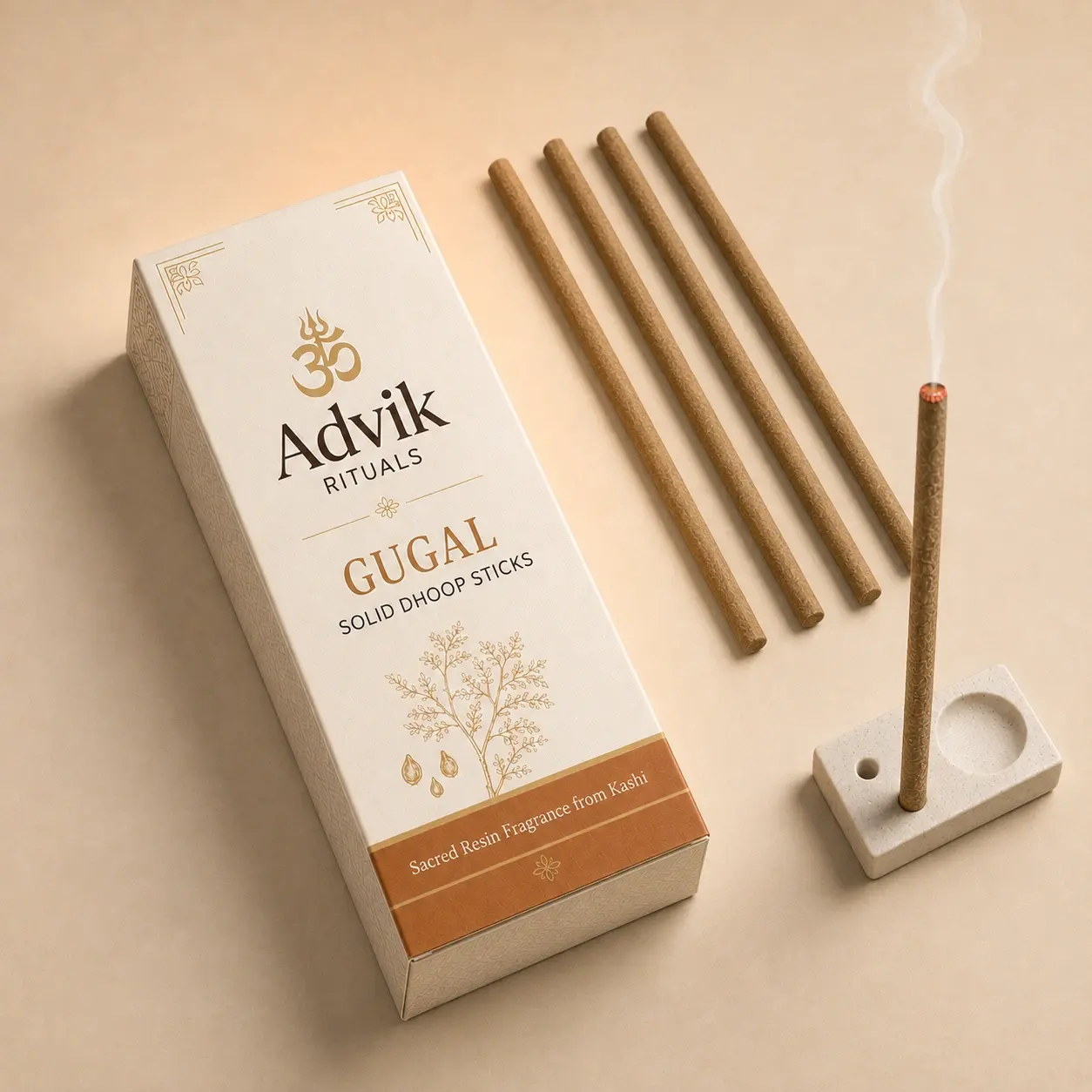
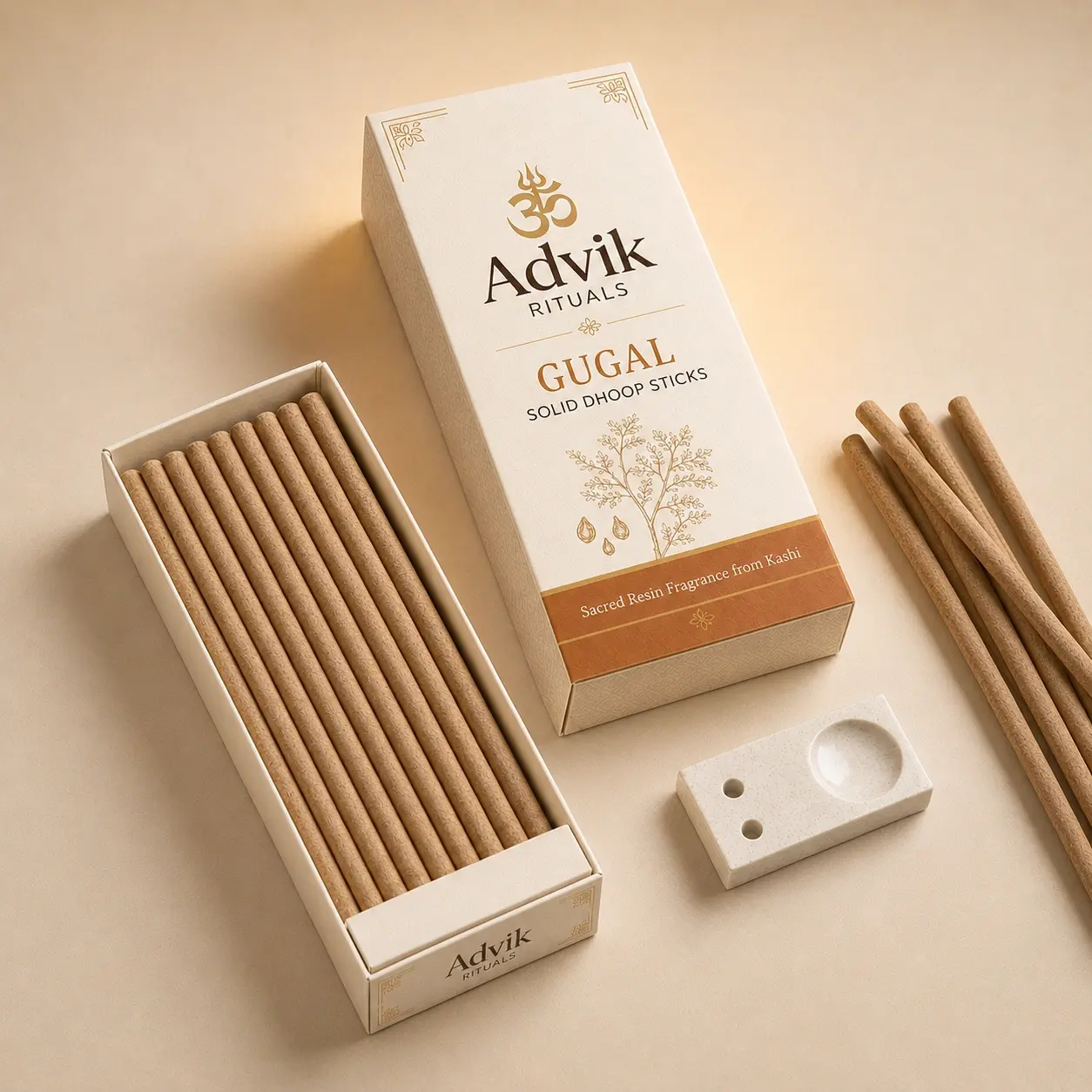
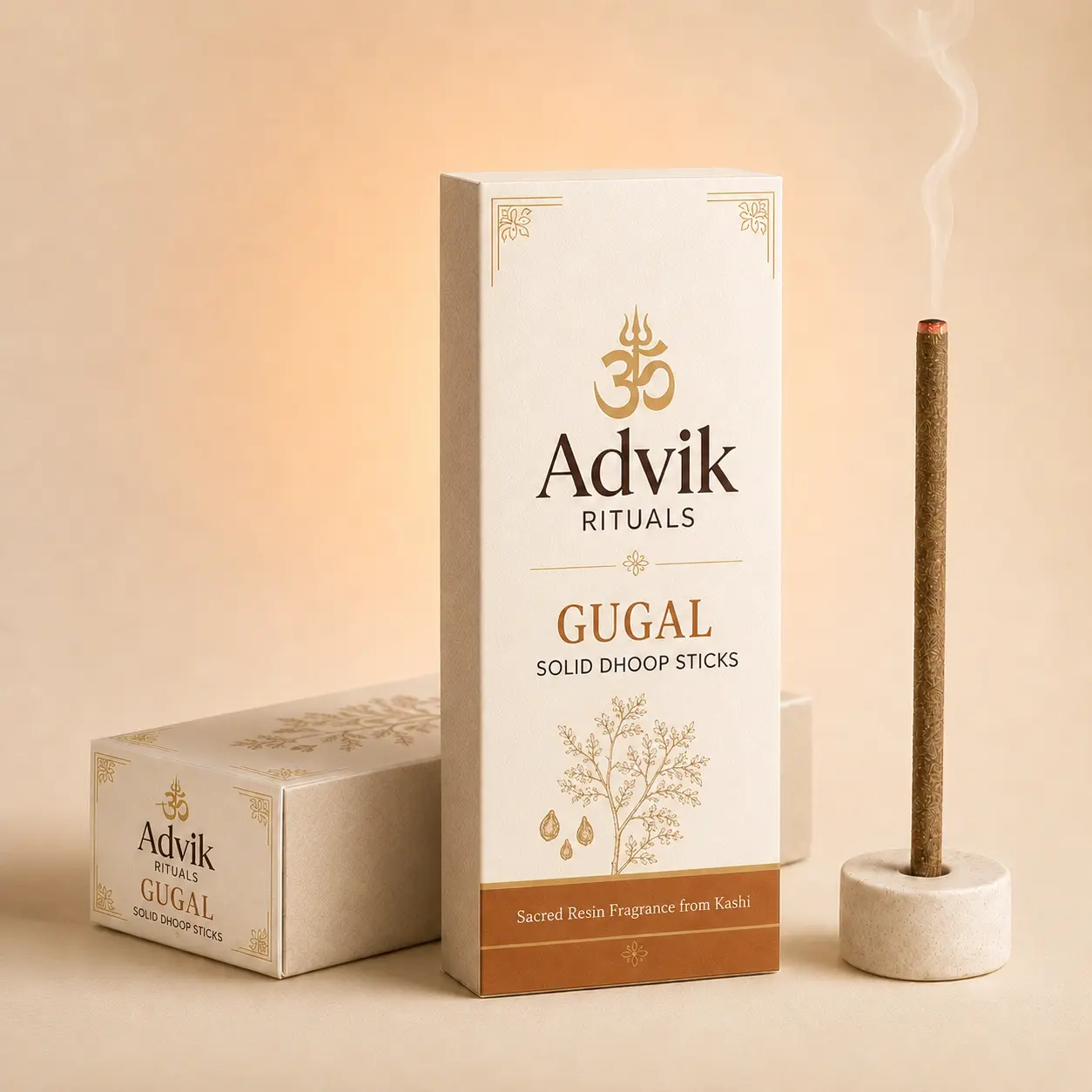


Gugal Bambooless Solid Dhoop
Guggal resin dhoop with no bamboo core — the deep, warm, resinous fragrance most people recognise as "the temple smell".
Heavier and more penetrating than any floral. This is the one you burn to purify a space, not to perfume it.


Hotline Order:
Mon - Sat: 07AM - 09PM
+91-92503 03205
The resin behind the temple smell
Guggal is the hardened resin of the Commiphora wightii tree, used in Indian ritual for millennia — offered in havan, burned as dhoop, and used to purify a space before puja. It is the single ingredient most responsible for what a temple smells like.
Of the eight fragrances in this range, guggal is the most traditional and the strongest. One stick is genuinely enough for a large room.
What "bambooless" actually changes
A standard agarbatti is incense paste rolled onto a thin bamboo stick. When you light it, the bamboo burns too — and burning bamboo has its own smell: a faint acrid woodsmoke that sits underneath every fragrance and is most obvious in the last third of the stick.
Solid dhoop has no core. The whole stick is the dhoop itself. What you smell is only the fragrance, the smoke volume drops noticeably, and there is no charred skewer left in the holder afterwards.
When gugal dhoop is burned
At the close of aarti, during or after havan, when purifying a space before a puja, at griha pravesh and Vastu rituals, and at dusk as part of the evening sandhya in many households.
If you want something for everyday background fragrance rather than ritual, chandan or mogra will suit better — guggal is dense by design.
How to burn it
- Light the tip, let it flame for two or three seconds, then blow the flame out so the tip glows.
- Stand it in an ash tray or a bed of ash rather than forcing it into a tight stick holder — solid dhoop is more brittle than a bamboo-core stick and snaps more easily.
- Place it on metal or ceramic. Never on cloth, wood or a painted surface.
- Let it burn down completely. It leaves only ash.
The full range — eight fragrances
All eight are the same bamboo-free solid dhoop. They differ only in fragrance, and they fall into two groups. It is worth knowing which is which before you buy.
Traditional ritual fragrances
These have long-standing places in Hindu worship and are what most households want for the mandir.
| Fragrance | Character | Best for |
|---|---|---|
| Chandan | Warm, dry, grounding | Daily mandir, meditation, Shiv & Vishnu puja |
| Gugal — you are here | Deep, resinous — the temple smell | Aarti, havan, purifying a space |
| Camphor | Clean, sharp, cooling | After aarti, Shiv puja, purifying a room |
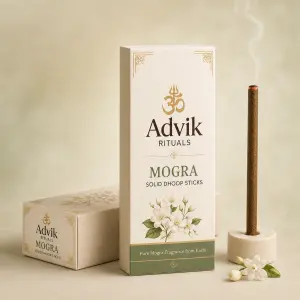
| Mogra | Rich, sweet jasmine — carries furthest | Evening aarti, Krishna & Lakshmi puja |
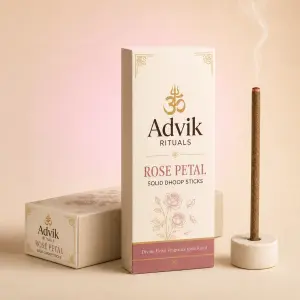
| Rose Petal | Soft floral — mildest of the six | Devi puja, Friday worship, daily use |
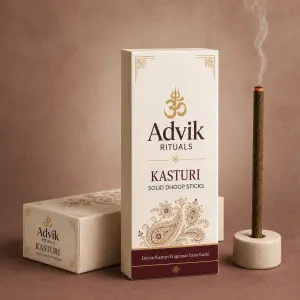
| Kasturi | Warm musk-amber | Evening puja, Devi worship, larger rooms |
Contemporary room fragrances
These are not traditional puja fragrances and we do not pretend otherwise. They are here because the bamboo-free format is genuinely better for everyday room scent.
| Fragrance | Character | Best for |
|---|---|---|
| Lavender | Clean, calm, herbal | Bedrooms, study rooms — not puja |
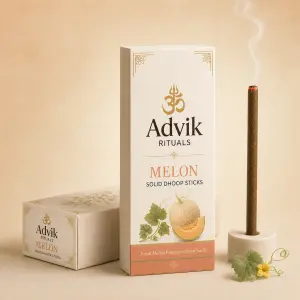
| Melon | Light, fresh, fruity — lightest of all | After cooking, guest rooms — not puja |
A note on smoke
All dhoop and incense produce smoke and particulates. Burn in a ventilated room, avoid small closed spaces, and take care around anyone with asthma or a respiratory condition. Keep burning dhoop out of reach of children and pets.
About Advik Rituals
We are based in Sigra, Varanasi (Kashi). We curate complete, pandit-verified puja kits and samagri so families can perform rituals correctly without hunting for individual items. Pure ingredients. Complete vidhi. Sacred blessings.
Add your review
Your email address will not be published. Required fields are marked *
Please login to write review!
Looks like there are no reviews yet.