
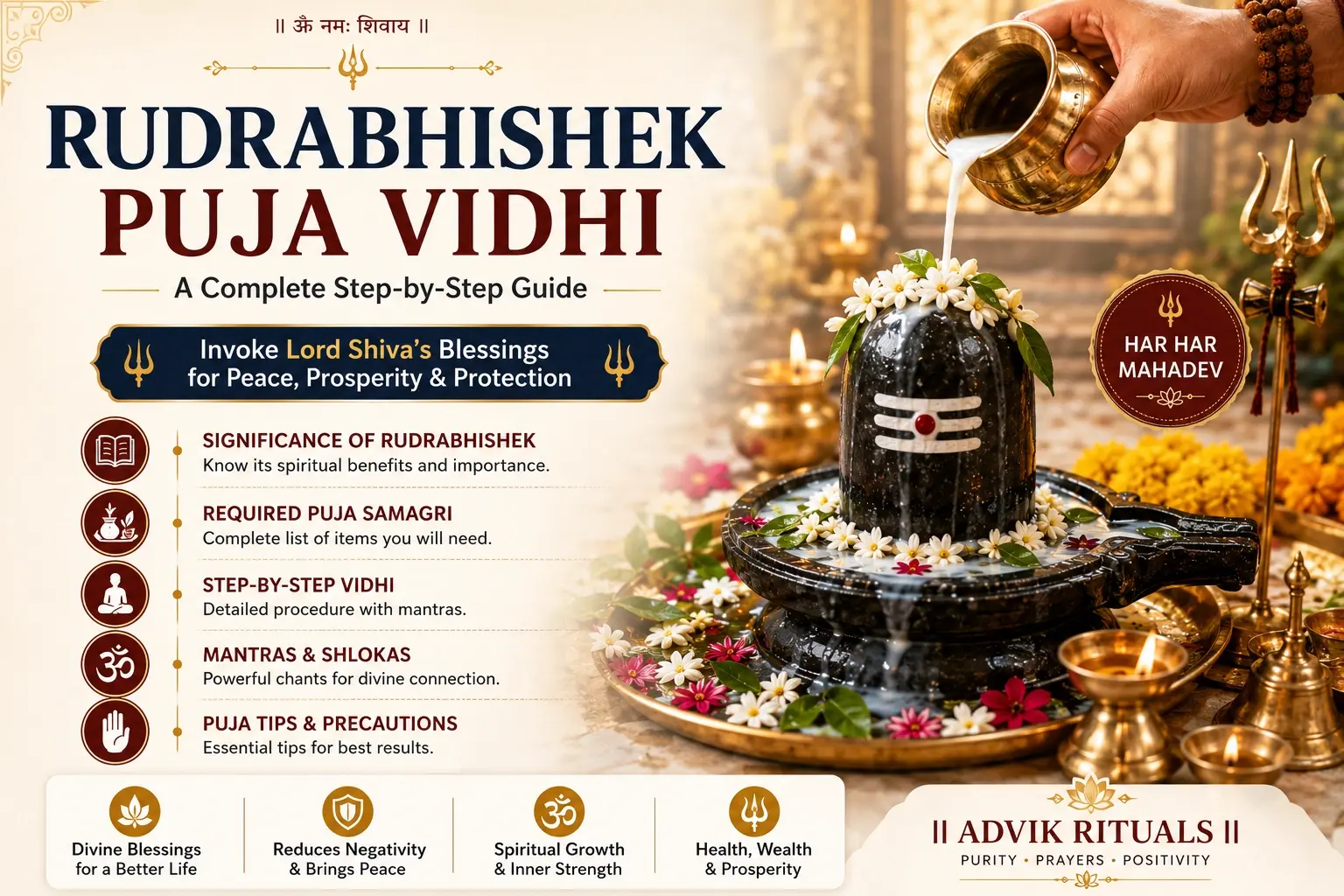
The complete Rudrabhishek puja vidhi — the abhishek dravya sequence in order, the full 45-item samagri list, the belpatr...
Most families performing Ganesh Chaturthi at home are not working from a book. They are working from memory, from what a grandparent did, and from whatever the pandit said last year. That works — but the sequence is easy to lose, and the parts most often dropped are the ones that matter: the sankalp, the pranapratishtha, and the uttar puja before visarjan.
This is the full sequence for a home sthapana in 2026, written to be followed on the day.
Bathe before beginning. Face east or north where possible. Spread the red or yellow cloth over the chowki and place a small heap of akshat where the murti will sit — the murti is never placed directly on bare wood.
Take water, akshat and a flower in the right palm. State your name, gotra, place and the reason for the puja, and the number of days you intend to observe. Release the water at the end.
The sankalp is the step most often skipped and it is the one that formally begins the observance. Do not skip it.
Install the murti on the akshat with both hands. Pranapratishtha is the invocation that invites the deity to reside in the murti for the duration of the festival — recite the mantras from your vidhi booklet, touching the heart of the murti with durva dipped in water.
From this moment the murti is treated as a guest in the house, not as an object. That is the reason for the daily bathing, dressing, feeding and the formal farewell at the end.
The classical home puja is a sequence of sixteen services. In order:
Close with pushpanjali and the Ganesh mantra: Om Gan Ganapataye Namah.
Durva is offered in 21 blades, tied in bunches of three, placed on the murti while chanting the names of Ganesha. Of everything in the vidhi, this is the offering most specifically his — and there is no accepted substitute.
Tulsi is one of the very few offerings traditionally forbidden in Ganesha worship. If your samagri list includes tulsi patra, leave it out. The reason is here.
Each day until visarjan, morning and evening:
Keep the kalash topped up. The lamp is traditionally kept burning through the festival where the household can attend to it safely.
Short on time? The Advik Rituals Ganesh Chaturthi Puja Kit carries the samagri side of this list in one box — 21 durva, red hibiscus and marigold garland, panchamrit for daily abhishek, modak bhog samagri, kalash with coconut and mango leaves, and a vidhi booklet. Hand-packed in Kashi (Varanasi).
On the final morning, before the murti is moved, perform the uttar puja: a last aarti, a last naivedya, and a formal request for forgiveness for any lapse in hospitality during the stay — anything forgotten, anything done incorrectly.
Only after the uttar puja is the murti moved. Moving it without this is the single most common mistake in home Ganesh Chaturthi.
Say Ganpati Bappa Morya, Pudhchya Varshi Lavkar Ya — come again soon next year.
Home visarjan is only possible with a clay idol. Plaster of Paris does not dissolve. Our eco-friendly clay Ganesh idols are made for immersion at home.
Regional traditions differ in detail. Where your family practice or your pandit differs from anything here, follow them.
Share:
The complete Rudrabhishek puja vidhi — the abhishek dravya sequence in order, the full 45-item samagri list, the belpatr...

The full Diwali and Lakshmi Puja samagri list for 2026, laid out day by day across all five days — with the Pradosh Kaal...

The full Navratri samagri list for 2026, grouped by ritual stage rather than alphabetically — with the four items no hon...

Tulsi is offered to almost every Hindu deity - but never to Ganesha. The Puranic reason, what to offer instead, and the...