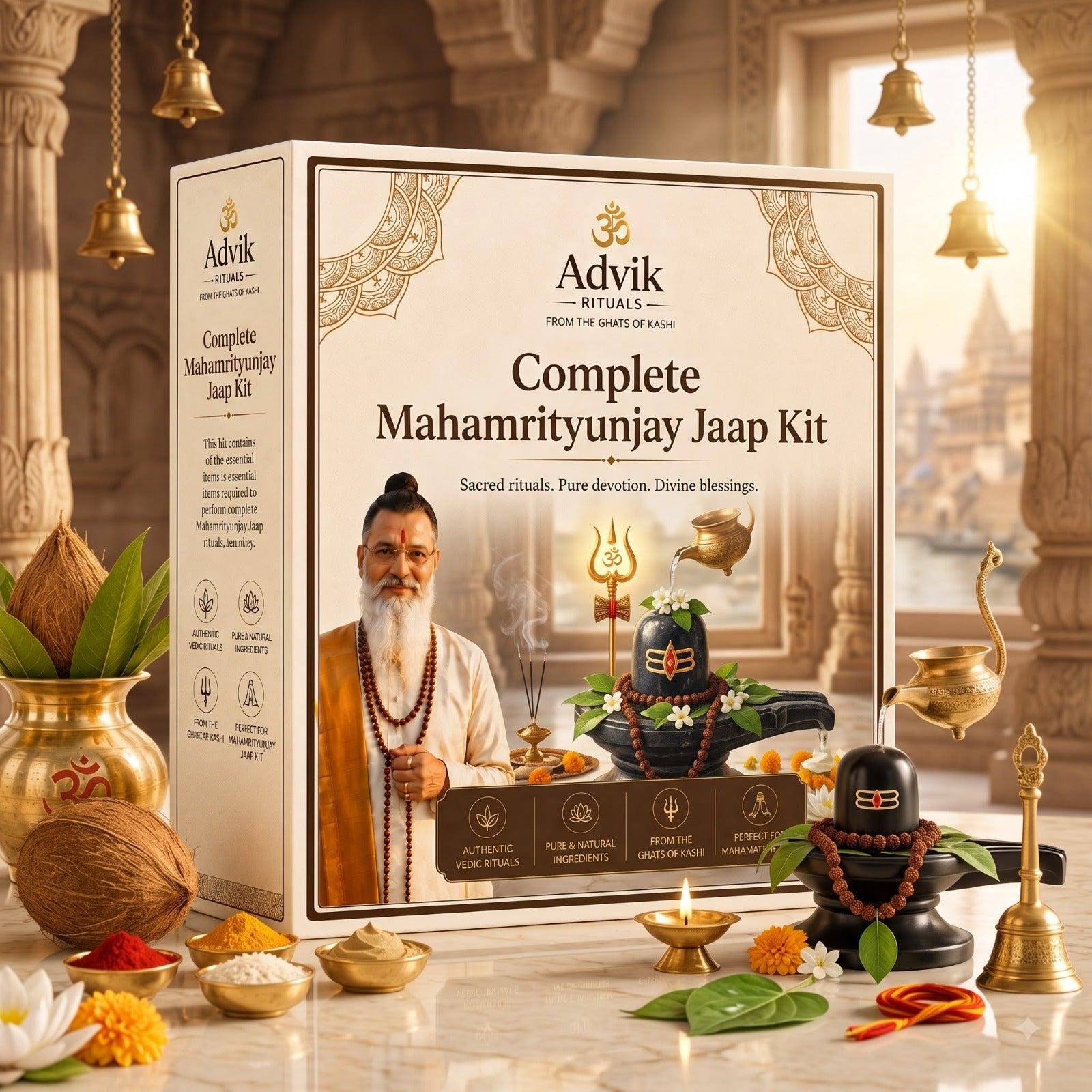
Complete Mahamrityunjay Jaap & Shiv Puja Kit


Hotline Order:
Mon - Sat: 07AM - 09PM
+91-92503 03205
Mahadev Ki Upasana, Sankalp Aur Jaap Ke Liye Sampoorna Samagri.
The Mahamrityunjaya Mantra is not recited casually. It is undertaken — a count is declared, a mala is set aside for it alone, and the recitation is kept up daily until the sankalp is complete. That is what separates an anushthan from a prayer, and it is what this kit is built for.
The Advik Rituals Mahamrityunjay Jaap Kit carries 48 essentials — a panchmukhi rudraksha mala with a gomukhi bag, the Shivling and full abhishek samagri, kusha, a complete havan with navgraha samidha, and five printed cards including an anushthan tracker. Curated in Kashi.
Choose a Count You Can Actually Finish
This is the part that decides whether an anushthan succeeds, and almost nothing sold online explains it.
A japa begins with a sankalp — you state, before Mahadev, how many repetitions you will complete. The traditional full anushthan is sava lakh: 1,25,000 repetitions. Tradition holds that a declared sankalp left unfinished is worse than one never made, so the number is chosen with care, not enthusiasm.
The arithmetic is simple, and worth doing before you declare anything. One mala is 108 repetitions.
| Daily practice | Repetitions per day | Days to complete 1,25,000 |
|---|---|---|
| 1 mala | 108 | about 1,157 days |
| 5 malas | 540 | about 232 days |
| 11 malas | 1,188 | about 106 days |
| 29 malas | 3,132 | about 40 days |
A 40-day anushthan means roughly three hours of japa every day without a break. That is a real commitment and most householders should not declare it. Eleven malas a day over about a hundred days is a far more completable sankalp — and a completed hundred-day anushthan is worth more than an abandoned forty-day one.
Many families instead declare a smaller count — 11,000 or 21,000 — and complete it properly. The tracker card in this kit exists so you can mark the count daily and know exactly where you stand.
What Is Inside — All 48 Essentials
Every weight and count below is what you actually receive.
| # | Item | हिन्दी | Quantity |
|---|---|---|---|
| Deity & Puja Cloth | |||
| 1 | Shivling / Mahadev Puja Symbol | शिवलिंग | 1 pc |
| 2 | Gauri-Ganesh | गौरी-गणेश | 1 set |
| 3 | White Puja Cloth | सफेद पूजा वस्त्र | 0.5 metre |
| 4 | Yellow Puja Cloth | पीला पूजा वस्त्र | 0.5 metre |
| Japa — Mala & Gomukhi | |||
| 5 | Panchmukhi Rudraksha Mala (108+1 beads) | पंचमुखी रुद्राक्ष माला | 1 pc |
| 6 | Gomukhi Jaap Bag | गोमुखी जाप थैली | 1 pc |
| Tilak, Bhasma & Akshat | |||
| 7 | Roli | रोली | 25 g |
| 8 | Kumkum | कुमकुम | 25 g |
| 9 | Haldi Powder | हल्दी पाउडर | 25 g |
| 10 | Chandan / Ashtagandha | चंदन / अष्टगंध | 25 g |
| 11 | Bhasma / Vibhuti | भस्म / विभूति | 25 g |
| 12 | Akshat / Puja Rice | अक्षत / पूजा चावल | 100 g |
| Abhishek, Thread & Fragrance | |||
| 13 | Gangajal | गंगाजल | 200 ml |
| 14 | Mauli / Kalawa | मौली / कलावा | 5 metre |
| 15 | Janeu | जनेऊ | 2 pcs |
| 16 | Puja Supari | पूजा सुपारी | 5 pcs |
| 17 | Puja Itra | पूजा इत्र | 5 ml |
| Kusha (Sacred Grass) | |||
| 18 | Kusha Grass | कुशा घास | 1 pack |
| 19 | Kusha Pavitra / Ring | कुशा पवित्री | 2 pcs |
| Grains & Havan Offerings | |||
| 20 | Whole Haldi | साबुत हल्दी | 5 pcs |
| 21 | Kala Til | काला तिल | 100 g |
| 22 | Jau | जौ | 100 g |
| 23 | Yellow Mustard | पीली सरसों | 50 g |
| 24 | Guggal | गुग्गुल | 25 g |
| Naivedya & Offerings | |||
| 25 | Mishri | मिश्री | 100 g |
| 26 | Panchmeva | पंचमेवा | 100 g |
| 27 | Laung | लौंग | 15 pcs |
| 28 | Elaichi | इलायची | 15 pcs |
| 29 | Dry Coconut / Gola | सूखा नारियल / गोला | 1 pc |
| 30 | Kamal Gatta | कमल गट्टा | 21 pcs |
| Deepak, Dhoop & Aarti | |||
| 31 | Premium Bambooless Agarbatti | बांस रहित अगरबत्ती | 20 sticks |
| 32 | Premium Dhoop | धूप | 10 pcs |
| 33 | Bhimseni Kapoor | भीमसेनी कपूर | 25 g |
| 34 | Cotton Round Batti | गोल रुई बत्ती | 25 pcs |
| 35 | Long Cotton Batti | लंबी रुई बत्ती | 10 pcs |
| 36 | Clay Diya | मिट्टी के दीपक | 5 pcs |
| Havan | |||
| 37 | Hawan Samagri | हवन सामग्री | 250 g |
| 38 | Samidha | समिधा | 1 pack |
| 39 | Navgraha Samidha | नवग्रह समिधा | 1 set |
| 40 | Gomay Havan Cakes | गोमय हवन कप | 4 pcs |
| 41 | Havan Cups | हवन कप | 4 pcs |
| 42 | Wooden Havan Spoon | लकड़ी की हवन चम्मच | 1 pc |
| 43 | Matchbox | माचिस | 2 pcs |
| Mantra, Sankalp & Tracker Cards | |||
| 44 | Mahamrityunjay Mantra Card | महामृत्युंजय मंत्र कार्ड | 1 pc |
| 45 | Mahamrityunjay Jaap Sankalp Card | जाप संकल्प कार्ड | 1 pc |
| 46 | Mahamrityunjay Puja Vidhi Card | पूजा विधि कार्ड | 1 pc |
| 47 | Jaap Counting / Anushthan Tracker | जाप गणना पत्रक | 1 pc |
| 48 | Rudrabhishek Fresh Items Checklist | रुद्राभिषेक ताज़ा सामग्री सूची | 1 pc |
The Mala and the Gomukhi Bag
A panchmukhi — five-faced — rudraksha is the variety most commonly prescribed for this japa, and the mala here is a full 108 beads plus the sumeru.
The gomukhi bag is the item most kits omit, and it is not decorative. The hand holding the mala goes inside it during japa. This keeps the count private, keeps the beads from being handled or seen by others, and holds the hand in the correct position — the mala rests on the middle finger and is moved with the thumb, and the index finger never touches the beads. On reaching the sumeru you turn the mala and come back; you do not cross it.
A mala taken up for a sankalp is kept for that mantra alone. Do not use it for other japa while the anushthan runs.
Why Kusha Is in a Japa Kit
The kusha grass is for the asan — the seat. Sitting directly on stone or tile during a long daily practice is traditionally avoided, and kusha is the prescribed seat. The two kusha pavitri are the rings worn on the finger during the ritual, and they belong to the puja and havan portion rather than the japa itself.
The Puja and Havan Sequence
- Shuddhikaran and sankalp. Purify the space with gangajal. Read the sankalp card, naming yourself, your gotra, the count you are undertaking and the person for whose wellbeing it is offered.
- Ganesh puja. Worship Gauri-Ganesh first.
- Abhishek. Bathe the Shivling with gangajal, and with panchamrit if you are preparing it. Apply chandan and bhasma.
- Offerings. Offer akshat, kamal gatta, mishri, panchmeva, dry coconut, and fresh belpatra arranged locally.
- Japa. Sit on the kusha asan facing east or north. With the mala in the gomukhi bag, recite the Mahamrityunjaya Mantra from the included card for the day's count.
- Havan — where performed. Kindle the fire with samidha and gomay cakes. Offer the 250 g samagri with kala til, jau, yellow mustard and guggal, and the navgraha samidha for the planetary offerings.
- Aarti. Close with the diya and Bhimseni kapoor. Mark the day on the tracker.
Belpatra and Panchamrit Are Arranged Fresh
Two things this kit deliberately does not ship, and you should plan for both:
Fresh belpatra. The bilva leaf is Shiva's own offering and no Shiva puja is complete without it. It must be fresh, and fresh leaves do not survive a courier. Source it locally, and offer the three leaves with the smooth side down.
Panchamrit. Milk, curd, honey, ghee and sugar for the abhishek — all perishable, all available in any Indian kitchen or shop, none of them shippable.
The Rudrabhishek fresh-items checklist card in this kit lists everything to buy on the morning.
What You Arrange Fresh
Fresh belpatra (bilva leaves) • Dhatura if your tradition uses it • Fresh white flowers • Milk • Curd • Honey • Ghee • Sugar • Seasonal fruit • Fresh prasad
When to Perform It
Brahma muhurta — roughly ninety minutes before sunrise — is the traditional hour for japa, though pradosh kaal is also used. Monday is Shiva's day, and Shravan month, Mahashivratri and the Trayodashi tithi are the strongest occasions to begin an anushthan. Most sankalps are started on a Monday and continued daily without a break until the count is complete.
A Note on Healing and Longevity Practices
The Mahamrityunjaya japa is a devotional practice with a long tradition behind it. It is performed for peace of mind and as part of a family's religious observance, alongside medical care — never in place of it. We make no claim about medical outcomes, and any seller who does should be treated with suspicion.
Related Shiva Kits
For the abhishek ritual itself, see the Rudrabhishek Puja Kit. For the fortnightly Trayodashi observance, the Pradosh Vrat Puja Kit, and for the festival, the Mahashivratri Puja Kit.
Product Highlights
- 48 curated Mahamrityunjay jaap and Shiv puja essentials
- Panchmukhi rudraksha mala, 108+1 beads, with a gomukhi jaap bag
- Shivling and Gauri-Ganesh set
- 200 ml gangajal, 25 g bhasma, chandan and 100 g akshat
- Kusha grass for the asan and two kusha pavitri
- Kala til, jau, yellow mustard, guggal and 21 kamal gatta
- Complete havan: 250 g samagri, samidha, navgraha samidha, 4 gomay cakes, 4 cups and a wooden spoon
- Complete aarti set with 5 clay diyas and Bhimseni kapoor
- Five printed cards — mantra, sankalp, puja vidhi, anushthan tracker and a Rudrabhishek fresh-items checklist
- Suitable for daily japa, anushthan, Shravan and Mahashivratri
- Curated in Kashi (Varanasi)
Please Note
Mahamrityunjay japa and Shiv puja procedures, mantra counts and samagri requirements vary according to region, sampradaya, family tradition and the guidance of your acharya. This kit contains commonly used non-perishable Shiv puja and japa essentials. Fresh belpatra and panchamrit ingredients are to be arranged locally. Please confirm any additional requirements with your pandit or acharya before beginning an anushthan.
About Advik Rituals
We are based in Sigra, Varanasi (Kashi). We curate complete, pandit-verified puja kits and samagri so families can perform rituals correctly without hunting for individual items. Pure ingredients. Complete vidhi. Sacred blessings.
Add your review
Your email address will not be published. Required fields are marked *
Please login to write review!
Looks like there are no reviews yet.